Fra Angelico, “Crucifixion”

fra-angelico-crucifixion.jpg

“In the chapter-house of S. Marco at Florence, the artist-saint, Fra Angelico, has painted the patrons of the city and the founds of the great religious orders—dedicated servants of the Eternal Charity—adoring the Crucified who is their Pattern, and from whom their mandate comes. There they are: real human beings of every type, transfigured by a single costly loyalty. There is Mark, the self-effacing writer of the earliest Gospel. There is the Magdalen, completely sanctified by penitence and love. There are the holy women, whose service was of the homeliest kind. There are Cosmo and Damian, the good and honest physicians. There too are the devoted scholars, Jerome, and Augustine; and Benedict, the creator of an ordered life of work and prayer. There are Francis, lost in an ecstasy of loving worship, and Thomas Aquinas gazing at the key to that great Mystery of Being to which he had given his vast intellectual powers. All these—mystics, lovers, teachers, scholars, workers—are linked with the Crucified, the Holy and Self-given, whose agents they are and from whom they draw power and love. The whole range of human accomplishment, in these its chosen representatives, is shown to us in direct and glad dependence on the very-flowing Charity of God. That is the very substance of religion. Like an immense impetus of generosity, it powers out from the Heart of Reality; self-given through generous and adoring spirits of every sort and kind, to rescue and transform the world” (Evelyn Underhill, The School of Charity p 58).

Evelyn Underhill on the creed: “Crucified”

A Christian’s belief about reality is a wonderful blend of confidence and experience. On one hand it asks great faith in the inivisible world that enfolds us. On the other hand it includes and embraces the hardest facts of the actual life we know, and gives them a creative quality. It is a religion which leaves nothing out. After the great phrases in which the Creed tries to describe or suggest the eternal Divine Nature, and the mystery of that Infinite God disclosing Himself in and through His creatures—incarnate by the action of the Holy Spirit of Charity—it goes on to a series of plain statements about the life of Christ. He was born, a baby; made man; entered completely into our human situation. He was crucified at a particular moment in the history of a particular country, suffered, was buried, and rose again to a new quality of life. This sequence of facts, deliberately picked out as specially significant moments in the revelation of Divine Charity to us, is not merely a series of symbolic or spiritual events. These things, on their surface so well known—but in their deep significance and bearing on life so carefully ignored by us—happened in time and space to a real man, a real body; of flesh and nerve and bone, accessible to all the demands of our physical nature and all the humiliations of physical pain. To the world He merely appeared a local prophet of somewhat limited appeal; yet endowed with the strange power of healing and transforming all lives given into His hand. Having roused the hostility of official religion by His generous freedom of love, He was condemned by a combination of political cowardice and ecclesiastical malice to a barbarous and degrading death; and made of that death the supreme triumph of self-abandoned Charity.

Continue reading “Evelyn Underhill on the creed: “Crucified””

Max Weber — “Specialists without spirit”

If you wish to purchase this seminal work, please follow this link.

“The Puritan wanted to work in a calling; we are forced to do so. For when asceticism was carried out of monastic cells into evervday life, and began to dominate worldly morality, it did its part in building the tremendous cosmos of the modern economic order. This order is now bound to the technical and economic conditions of machine production which to-day determine the lives of all the individuals who are born into this mechanism, not only those directly concerned with economic acquisition, with irresistible force. Perhaps it will so determine them until the last ton of fossilized coal is burnt. In Baxter’s view tile care for external goods should only lie on the shoulders of the “saint like a light cloak, which can be thrown aside at any moment”. But fate decreed that the cloak should become an iron cage.

Since asceticism undertook to remodel the world and to work out its ideals in the world, material goods have gained an increasing and finally an inexorable power over the lives of men as at no previous period in history. To-day the spirit of religious asceticism-whether finally, who knows?-has escaped from the cage. But victorious capitalism, since it rests on mechanical foundations, needs its support no longer. The rosy blush of its laughing heir, the Enlightenment, seems also to be irretrievably fading, and the idea of duty in one’s calling prowls about in our lives like the ghost of dead religious beliefs. Where the fulfilment of the calling cannot directly be related to the highest spiritual and cultural values, or when, on the other hand, it need not be felt simply as economic compulsion, the individual generally abandons the attempt to justify it at all. In the field of its highest development, in the United States, the pursuit of wealth, stripped of its religious and ethical meaning, tends to become associated with purely mundane passions, which often actually give it the character of sport.

No one knows who will live in this cage in the future, or whether at the end of this tremendous development, entirely new prophets will arise, or there will be a great rebirth of old ideas and ideals, or, if neither, mechanized petrification, embellished with a sort of convulsive self-importance. For of the fast stage of this cultural development, it might well be truly said:’ “Specialists without spirit, sensualists without heart; this nullity imagines that it has attained a level of civilization never before achieved” (The Protestant Ethic and the Spirit of Capitalism, p123-124).

John Chrysostom on church buildings

With all this talk lately about “church” and “emerging church” and “cell church” I thought I would archive this from one of John Chrysostom’s sermons on the Book of Acts (Homily XXIX).

Think you that to be religious is to be constant in Church-going? This is nothing, unless we reap some fruit for ourselves: if (from gathering together in Church) we do not gather something for ourselves, it were better to remain at home. For our forefathers built the Churches for us, not just to bring us together from our private houses and show us one to another: since this could have been done also in a market-place, and in baths, and in a public procession:–but to bring together learners and teachers, and make the one better by means of the other. With us it has all become mere customary routine, and formal discharge of a duty: a thing we are used to; that is all. Easter comes, and then great the stir, great the hubbub, and crowding of–I had rather not call them human beings, for their behaviour is not commonly human. Easter goes, the tumult abates, but then the quiet which succeeds is again fruitless of good. “Vigils, and holy hymn-singing.”– And what is got by these? Nay, it is all the worse. Many do so merely out of vanity.

People change, but not that much. Sermons change, but not that much.

Pelikan’s commentary on Acts 9 — The first “conversion”

titian_annunciation.jpg

In the context of the larger account of Luke-Acts, the singular “conversion” story with which that entire account begins is the annunciation of the Blessed Virgin Mary (Luke 1:26-28), which the Greek Orthodox liturgy and the Greek church fathers called her “evangelization”. Although the annunciation demonstrated, according to Saint Gregory of Nyssa, that “the power of the Godhead is an immense and immeasurable thing, while man is a weak atom,” and although the Virgin Mary was divinely predestined and chosen to become the Theotokos, the Mother of God, nevertheless the incarnation took place at her voluntary and unconstrained response to the angel: “Behold, I am the handmaid of the Lord; let it be to me according to your word” (Luke 1:38). That was why, according to Dante and the Florentine tradition, the beginning of the new age of human history was to be dated from the annunciation rather than from the nativity. In the words of Irenaeus about Eve and Mary, “If the former did disobey God, yet the latter was persuaded to be obedient to God, in order that the Virgin Mary might become the patroness of the virgin Eve” (SCM Theological Commentary on the Bible).

Charles Williams’ play “Thomas Cranmer of Canterbury”

There are some people in my parish who are wanting to put on this play by Charles Williams.  They’re a talented lot, and it would be interesting to see.  I think it would require an accompanying commentary though.  I put it on here because this mildly adapted script may be of value to Charles Williams fans…  It used to be out of print, but appears now (2016) to be back in print.  There are some minor errors that occurred during the scanning process.  If any one wants a micro$haft word copy send me an email and I’ll send you one…

First produced in the Chapter House, Canterbury, as part of the Festival of the Friends of Canterbury Cathedral, 20 June 1936
THOMAS CRANMER Robert Speaight
HENRY VIII Philip Hollingworth
MARY Vera Coburn Findlay
FIRST LORD Jeffrey Leighton
SECOND LORD Frank napier
A PRIEST Sidney Haynes
A PREACHER William Fordyce
A BISHOP William Gorman
FIGURA RERUM, A SKELETON E. Martin Browne
The Commons; Singers; Executioners
The character of ANNE BOLEYN was not included in the somewhat shorter version of the play given at Canterbury
Directed by E. Martin Browne

Continue reading “Charles Williams’ play “Thomas Cranmer of Canterbury””

St. Augustine — Freedom of the will

Unless you turn to Him and repay the existence that He gave you , you won’t be “nothing”; you will be wretched. All things owe to God, first of all, what they are insofar as they are natures. Then, those who have received a will owe to Him whatever better thing they can will to be, and whatever they ought to be. No man is ever blamed for what he has not been given, but he is justly blamed if he has not done what he should have done; and if he has received free will and sufficient power, he stands under obligation. When a man does not do what he ought, God the Creator is not at fault. It is to His glory that a man suffers justly; and by blaming a man for not doing what he should have done, you are praising what he ought to do. You are praised for seeing what you ought to do, even though you see this only through God, who is immutable Truth (On Freedom) 

Kierkegaard — On Self and Passion

Follow this link to purchase the book.

Kierkegaard’s understanding of “passion” is different from many writers of the early church who sought to quell passion in the soul. Here passion does not refer to inordinate desire, but rather to the awareness of the significance of one’s existence and actions.

It is impossible to exist without passion, unless existing means just any sort of so-called existence. For this reason every Greek thinker was essentially a passionate thinker. I have often wondered how one might bring a man to passion. So I have thought I might seat him on a horse and frighten the horse into a wild gallop, or still better, in order to bring out the passion properly, I might take a man who wants to go somewhere as quickly as possible (and so was already in a sort of passion) and seat him on a horse that can barely walk. But this is just how existence is, if one becomes conscious of it. Or if someone hitched a carriage with Pegasus and an old nag, and told the driver, who was not usually inclined to passion, “Now, drive”: I think that would succeed. And this is just how existence is, if one becomes conscious of it. Eternity is the winged horse, infinitely quick, and time is the old nag, and the existing individual is the driver; that is to say, he is the driver when his existence is not merely a so-called existence, for then he is no driver, but a drunken peasant who sleeps in the wagon and lets the horses fend for themselves. True, he also drives, he is a driver, and so there are perhaps many who–also exist.

Søren Kierkegaard, Concluding Unscientific Postscript to the Philosophical Crumbs, trans Alastair Hannay, (Cambridge: Cambridge University Press, 2009) 260-261.

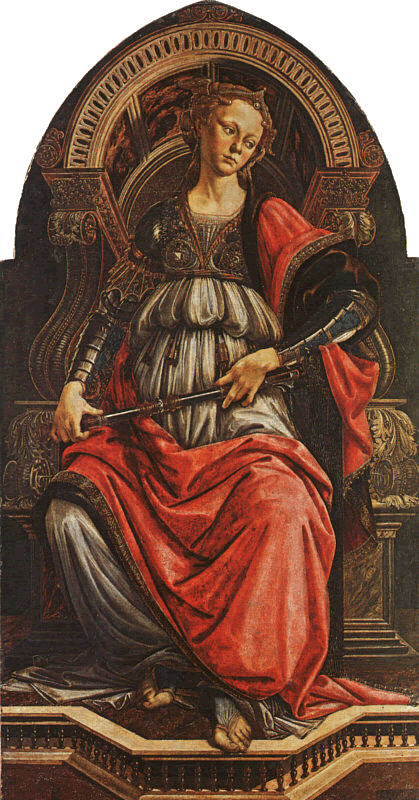
Botticelli — Fortitude

fortitude.gif

“What is chiefly notable in her is–that you would not, if you had to guess who she was, take her for Fortitude at all. Everybody else’s Fortitudes announce themselves clearly and proudly. They have tower-like shields and lion-like helmets, and stand firm astride on their legs, and are confidently ready for all comers. But Botticelli’s Fortitude is no match, it may be, for any that are coming. Worn, somewhat; and not a little weary, instead of standing ready for all comers, she is sitting, apparently in reverie, her fingers playing restlessly and idly–nay, I think, even nervously–about the hild of her sword. For her battle is not to begin to-day; nor did it begin yesterday. Many a morn and eve have passed since it began–and now–is this to be the ending day of it? And if this–by what manner of end? That is what Sandro’s Fortitude is thinking, and the playing fingers about the sword-hilt would fain let it fall, if it might be; and yet, how swiftly and gladly will they close on it, when the far-off trumpet blows, which she will hear thorugh all her reverie!” (J. Ruskin, “Mornings in Florence,” iii. 57.58. Quoted from “The Spirit of Discipline” by F. Paget, p. 50).